Cellular Energetics and Membrane Structure
Energy level of interactions in cells is related to function:
- strong interactions (carbon-carbon bonds: 83 kcal/mole or 350 kJ/mole) ensure stable structures. This is much larger than thermal energy (2.4 kJ/mole). If this is put into the Boltzmann distribution one would get 8 x 10-64!! …a low probability of breakage.
- Weak interactions (H-bonds: ~20 kJ/mole) can be easily broken. In the Boltzmann distribution one get 2 x 10⁻⁴
 Membrane Strength and Energy
- The Boltzmann distribution can be applied to bond strength in a cell membrane.
o In terms of energy, a phospholipid with two hydrophobic hydrocarbon chains has a strong interaction energy (100 kJ/mole), and therefore a very low probability of spontaneously leaving the membrane (10-19).
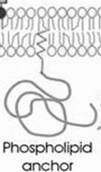
o Anchored proteins with only one hydrocarbon chain inserted in the membrane’s bilayer have half the energy (50 kJ/mole) of a phospholipid and can be removed easily (probability ratio of 10-10). (see figure to right)
§ More specifically, an anchored protein can be removed from the negatively charged membrane by repulsion: protein phosphorylation introduces negative charges and this repulsion weakens the interaction energy with the membrane.
- Membranes need to be both strong and fluidity. Fluidity requires non-covalent interactions between membrane components. This combination of factors allows cells to be very deformable.
o Ex. leukocytes have a membrane that is strong enough to prevent lysing, yet weak enough to flatten and change shape as they travel through tissues.
Membrane Compartmentalization
- Compartmentalization is necessary to prevent equilibrium between the cell and its external environment- it is necessary for the cell to be able to properly perform its functions. Life requires the presence of many components working under very narrow environmental conditions.
o However, the cell cannot function as an isolated system. It is a dissipative structure. Selective permeation, including specific transport systems, allows selective flow through membranes. The kinetics of these processes are critical to life and fast kinetics require thin membranes. Here again there is a trade-off between thin structures and stable structures.
Force: Change in free energy with distance 