Cooperative Breeding
A. Cooperative breeding is a social systems in which some group members defer thier own reproduction, even as adults, and help care for the young of a few breeding individuals
B. Helpers are typically related to breeders and are often individuals that do not disperse instead aid in the rearing of their siblings
C. In a very few cases, helpers are not related to breeders or to the young they help rear (e.g. dwarf mongooses, wild dogs)D. Cooperative breeding is relatively rare -- found in only about 3% of birds and mammals (roughly 200-300 bird species and about 120 mammal species)
II. Two important steps in the evolution and expression of cooperative breeding
A. STEP 1 -- Potential helpers must decide whether to disperse and attempt to breed on their own or to remain in their natal group and accept a nonreproductive position
Why not disperse? Two hypotheses
[1] Habitat or mate saturation hypothesis -- the probability of successful dispersal and breeding is low because of lack of availabile habitat or mates, so you may be better off staying where you are until your chances of successful dispersal improve
[2] Group-living advantages hypothesis -- the benefits of group-living (such as we've talked about before) may be great enough to outweigh the costs of foregoing reproduction
Most evidence supports the first hypothesis
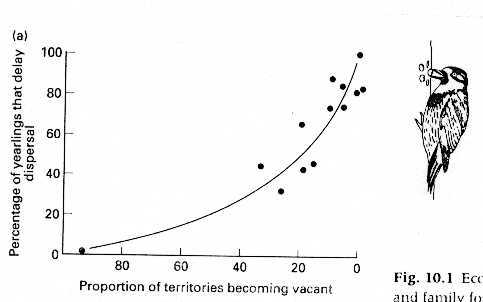
Ex. In acorn woodpeckers, as the shortage of territories becomes more severe, a greater proportion of yearlings delay dispersal
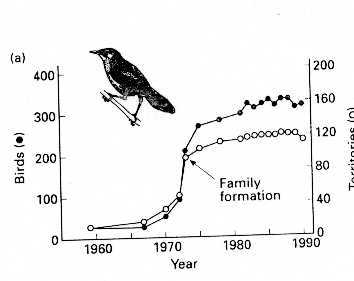
Ex. When cooperatively-breeding Seychelles warblers introduced onto a vacant island, all young dispersed to begin reproducing on their own. But as available territories became filled up, family breeding units began to form again.
B. STEP 2 -- If potential helpers decide to remain in their natal groups, they must decide whether or not to provide help
Why provide help? Several possible reasons
[1] To increase your own inclusive fitness
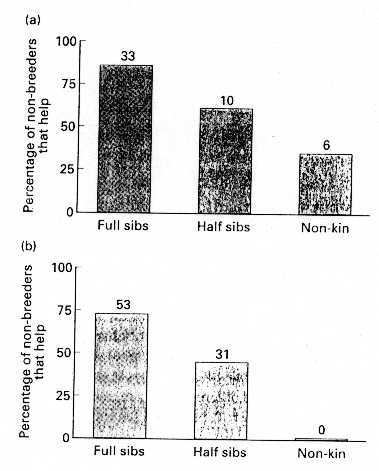
Requires that helpers be relatives of breeders and predicts that the degree of helping will covary with the degree of relatedness of the helper to the recipient
Ex. In scrub jays (top) and Seychelles warblers (bottom) the percentage of nonbreeders in a group who help is greater when potential helpers are more closely related to nestlings
So how can helpers increase their own inclusive fitness?
A. By improving the survival of breeders
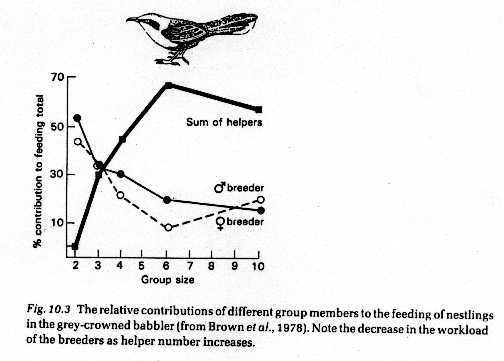
Ex. In grey babblers, parents with helpers provide much less of total food to young, and therefore, presumably, have greater survivorship themselves
B. By improving reproductive output of breeders
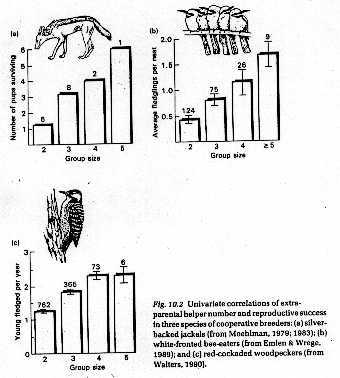
C. By improving helper's own chance of survival (e.g. through benefits of grouping)
D. Note: must control for other factors such as territory quality
[2] To enhance own breeding opportunities
A. Nonreproductive group members may be more likely to inherit a territory (though this is not well-documented)
B. Helpers may be able to inherit a mate when a former breeder dies
C. Helpers may recruit siblings they have helped raise as coalition partners to acquire mates or territories
Ex. In lions, brothers may emigrate together to form a new group or take over a pride and then share mating opportunites
[3] To gain parenting experience
A. In several species of callitrichid primates, individuals that have helped rear their siblings have a better chance of having their own offspring survive to weaning
B. Reproductive output (clutch size) in some species of birds increases with experience both as a breeder and as a helper
References
Arnold, W. & J. Dittemi 1997 Reproductive suppression in male alpine marmots.
Anim. Behav. 53:53-66.
Boland, C.R.J., R. Heinsohn, R. & A. Cockburn 1997 Deception in helpers in cooperatively
breeding white-winged choughs and its experimental manipulation. Behav. Ecol. Sociobiol.
41: 251-256.
Brown, J.L. 1987 Helping and Communal Breeding in Birds. Princeton University Press,
Princeton.
Clutton-Brock, T.H. 1998 Reproductive skew, concessions, and limited control.
Trends Ecol. Evol. 13:288-292.
Creel, S.R., Monfort, S.L., Wildt, D.E. and Waser, P.M. 1991 Spontaneous lactation
is an adaptive result of pseudo-pregnancy. Nature 351:660-662.
Creel, S., Creel, N. & Monfort, S.L. 1996 Social stress and dominance. Nature
379:212.
Emlen, S.T. 1991 Evolution of ccoperative breeding in birds and mammals. In Behavioral
Ecology: An Evolutionary Approach, Third Edition. eds J.R. Krebs and N.B. Davies,
pp. 301-337. Blackwell Scientific Publications, Cambridge.
Emlen, S.T. 1992 Parent-offspring conflict and the recruitment of helpers among bee-eaters.
Nature 356:331-333.
Emlen, S.T. 1994 Benefits, constraints and the evolution of the family. Trends Ecol.
Evol. 9:282-285.
Emlen, S.T. 1995 An evolutionary theory of the family. Proc Natl Acad. Sci 92:8092-8099.
Frank, S.A. 1996 Policing and group cohesion when resources vary. Anim. Behav. 52:1163-1169.
Jamieson, I.G. 1989 Behavioral heterochrony and the evolution of birds' helping at
the nest: an unselected consequence of communal breeding? Am. Nat. 133:394-406.
Jamieson, I.G. 1997 Testing reproductive skew models in a communally breeding bird,
the pukeko, Porphyrio porphyrio. Proc. R. Soc. Lond. B264:335-340.
Koenig, W. and R. Mumme 1990 Cooperative Breeding in Birds: Long-term Studies of
Ecology and Behavior. Cambridge University Press, Cambridge.
Komdeur, J. 1992 Importance of habitat saturation and territory quality for the evolution
of cooperative breeding in the Seychelles warbler. Nature 358:493-495.
McRae, S.B. 1996 Family values: costs and benefits of communal nesting in the moorhen.
Anim. Behav. 52:225-245.
Pruett-Jones, S.G. and M.J. Lewis 1990 Habitat limitation and sex ratio promote delayed
dispersal in Superb fairy wrens. Nature 348:541-542.
Reeve, H.K. & P. Nonacs 1992 Social contracts in wasp societies. Nature 359:
823-825.
Reeve, H.K. & L. Keller 1995 Partitioning of reproduction in mother-daughter
versus sibling associations: a test of optimal skew theory. Am. Nat. 145:119-132.
Schoech, S.J., R.L. Mumme & J.C. Wingfield 1996 Prolactin and helping behaviour
in the cooperatively breeding Florida scrub jay, Aphelocoma c. coerulescens. Anim.
Behav. 52:445-456.
Vehrencamp, S.L. 1983 A model for the evolution of despotic versus egalitarian societies.
Anim. Behav. 31: 667-682.