Robert Evan Snodgrass: No...no, don't think so. Well,
we'll… we'll go back to where we left the embryo the last time… I'll put
this diagram up...
<DRAWING ON CHALK BOARD>
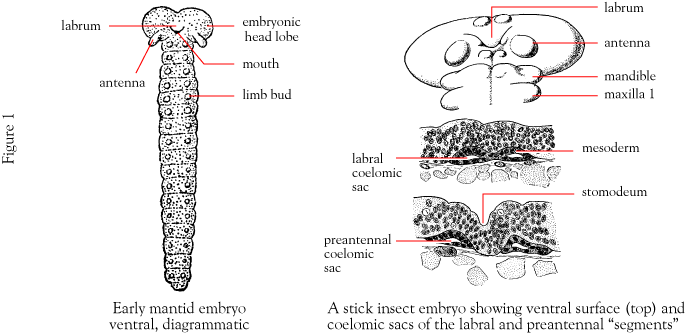
Well, the question is… that I left you with the last time… are there segments up in that head lobe? Well, as I said, there are these embryologists who claim that that region is segmented, because they found in it two or three pairs of small cavities in the mesoderm. And they claim that wherever there are cavities like that in the mesoderm, called coelomic sacs, that that means… that is segmentation. But I contend that that is not necessarily segmentation unless you've got evidence of segments in the body wall itself. Because we know the segments of any arthropod or insect; it's the subdivision of the body wall [that is] independently musculated and independently moveable. And, therefore, you might call them motor units [1]. Well, so, it all depends on definition, since there's no evidence externally of segmentation in that part of the head.
And another thing that's rather embarrassing to the … to the coelomic-sac interpretation is that a number of investigators have found a pair coelomic sacs in the labrum itself, and yet they do not admit that the labrum is a segment. I mean, those that base their interpretation on the coelomic sacs, they accept the two pairs corresponding with the antennae and the preantennal pair as evidence of segmentation, but they won't accept those in the labrum as segments, so there's an inconsistency in their own argument.
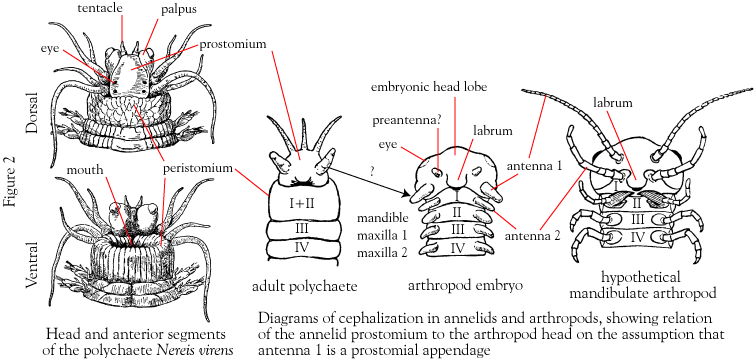
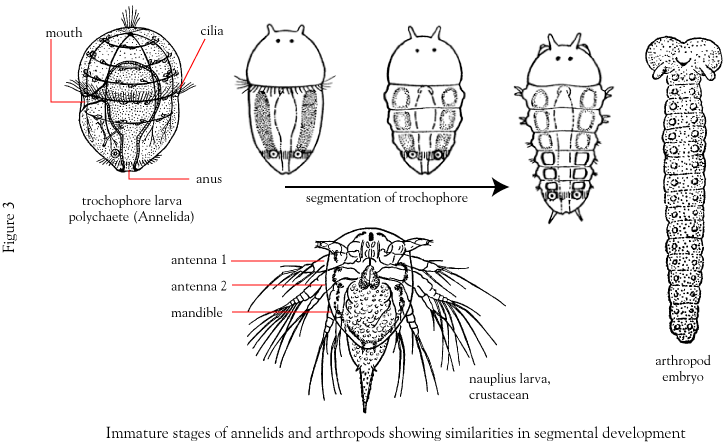
So, if anybody wants to know what theory I recommend, I'd say that of Holmgren and Hanström. Hanström is the author of the large textbook I have on the comparative structure of the arthropod nervous system [3]. Because then when you consider that the ...the identical structure... the internal structure of the brain of all these forms, why it gives extra reason for accepting this theory as the most probable one we have. But if anybody wants to put ... as embryologists do ... they want to put their faith in a cavity in the mesoderm. It might be very simply be for the accumulation of waste products, even in the embryo. So, I don't think you can put too much faith in the presence of a cavity in the embryo of being necessarily an indication of segments. Because otherwise you'd have to suppose that that lobe here that once was composed of two or three moveable segments besides the prostomium.
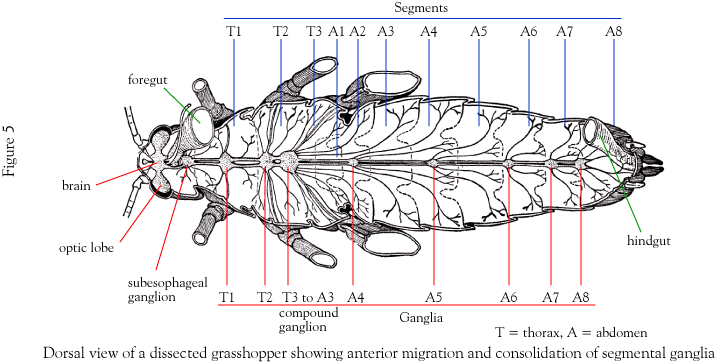
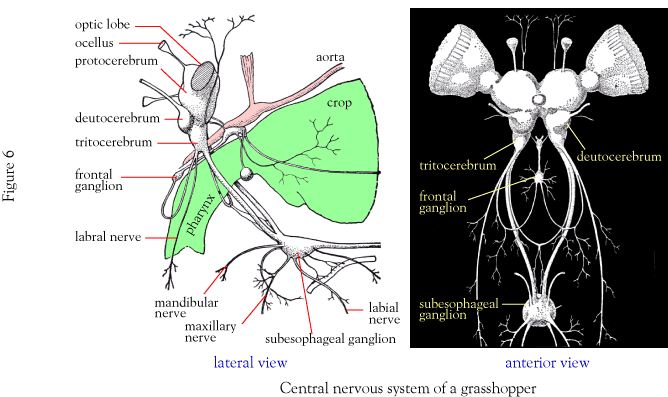
<DRAWING> [?]... There's the clypeus and labrum hanging down here, and the mouth is there, and the esophagus curves back that way and goes to the back of the head. And the brain lies back in here. But the brain is turned backward and is composed of three parts. The third part here straddles the esophagus and that innervates the part of the brain down here ... Well, so, the brain usually turns backward in the head because this central [?] part there innervates the antenna and this part in the front [?] but the antenna begins in development behind the eyes. But the brain [?] regardless of that. That would be ocular center, [?] center.. That is what you call the tritocerebral ganglion. It isn't necessarily so big as that; it straddles the esophagus, more or less. Well, now, this ganglion down here you see is part of the nerve chain of the gut. This is the subesophageal ganglion down here. Well, now there's another ganglion that lies up in here called the frontal ganglion, and it's innervated from the tritocerebrum … This little ganglion on each side of that [?] and then from this the nerve that connects with the tritocerebral ganglion, there's a nerve that goes down here and to the labrum … Now, if you draw that… draw that down from the top it'll show better ... Suppose there we have the tritocerebral ganglion [it has all the other ganglia on top of it?] And this frontal ganglion would be up here and its connectives would go up in this fashion… and then from these connectives…There's the labrum ... Nerves come off from those…
Now, looking at that pattern of nerve connections and
branchings without knowing anything else about it… We've always said --
all the books, papers about the nervous system of the head…. Well, I've
said the same thing, I think -- that nerves ... a pair of nerves comes
off from the tritocerebral ganglia and divides into two. The median branch
goes to the frontal ganglion and the outer branch goes to the labrum.
Well, that simply describes what you see, and ... on ... but ... from
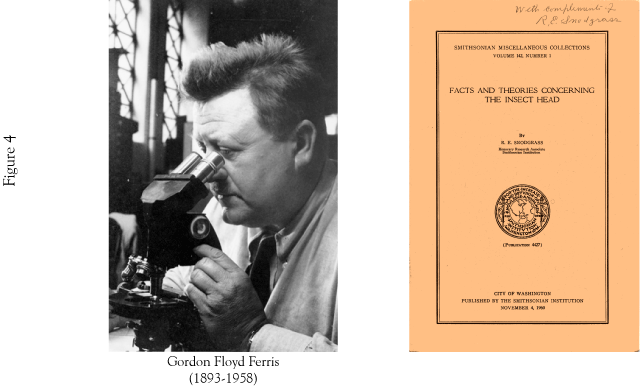
that apparent fact why Ferris and Henry have, borrowing what they have
over here in the abdomen -- I mean, taking that general principle "segments
can be identified by the nerve that goes to them" -- they claim that the
labrum, being innervated from the tritocerebral ganglia, is the segment
of the head. Does sound logical on the face of it, but considering
the innervation and the law of innervation of the ... relation between
nerves and ganglia, segments. it sounds quite logical. Well, if any of
you have encountered it...I don't doubt that it's rather ... well, it's
rather confusing. I know that [?] students have been puzzled to know what's
wrong with the theory. It certainly doesn't sound right. And no morphological
entomologists have accepted it that I know of, and most of them say it's
ridiculous. But it follows the general rule of nerves, so what're you
going to do about it?
Well, there is a catch. Of course, the tritocerebral ganglion, here, was
never near the labrum, but it should be if its the ganglion of the labrum
and the labrum is a segment. Well, since ganglia can move, a shown in
the abdomen, why, it's safe to say, the ganglion of the labrum has moved
backward and inserted itself between the antennal part of the brain and
the ventral nervous system. Well, that again is kind of mysterious how
it got in there. Now on that point they don't elaborate at all, but that's
just a way of explaining why the ganglion is away from its segment. It's
been moved backward and been inserted between the brain and the subesophageal
ganglion. Well, so now that sounds altogether so farfetched and so different
from anything that we've ever thought of before. So the [?] I don't know
anybody that has accepted it except Ferris' thoroughly indoctrinated students.
They all have to believe it, and they all carried it through to their
published papers. Some of them.
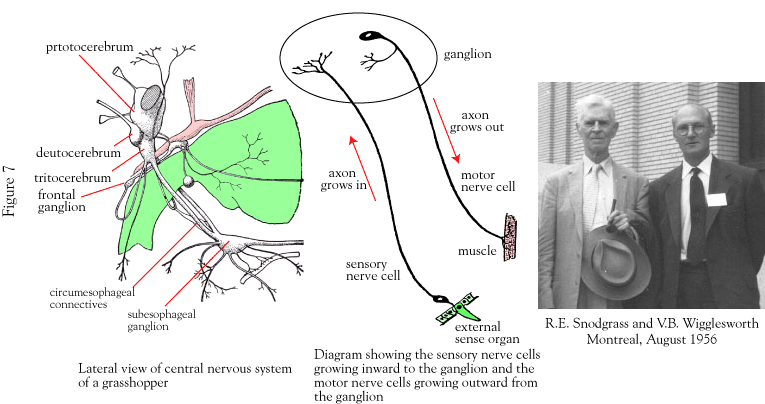
So, it's altogether wrong to say that those nerves grow out from the ganglia to the labrum. They grow just the other way.
[Sir Vincent B.] Wigglesworth [7] just recently has had two papers or publications showing just how sensory nerves do grow in from the epidermis. The real nerve cells... epidermal cells have become nerve cells. So, it's quite wrong, then, to say that those nerves grow out to the labrum. Just the opposite is true; they grow in toward the ganglion, and they unite with the connectives of the frontal ganglion in order to get into the ganglion. And, you see, sensory nerves have to connect with the motor system in the nervous centers. Because, they're insects, they don't simply don't feel or smell, the way we do, they give a reaction which has to.... The stimulus of a sensory nerve has to produce some kind of motion. It either goes after something because ... either its food or it has to avoid it, one way or the other. So, I say, with the insect, the collection of sensory nerves, especially from the... is to produce a motion of the animal that will be advantageous to it one way or another.
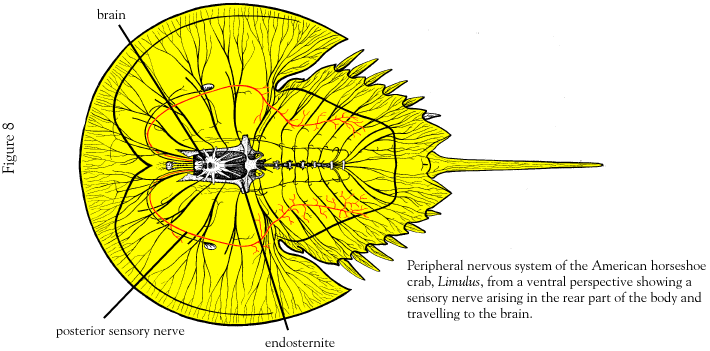
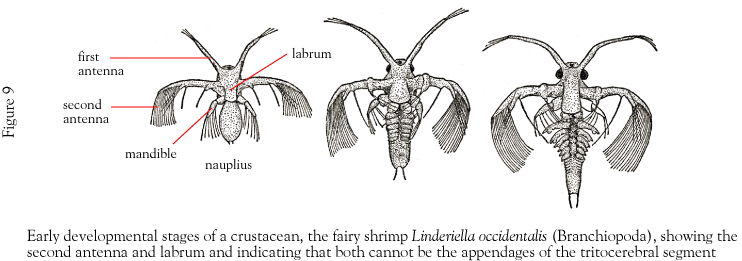
We can eliminate all these funny theories, except that of Holmgren and Hanstrom, which I think is worth considering as the most probable way of explaining this. But otherwise, as I say, we can go back to our old-fashioned ideas we don't have to accept any of these new fangled ways of explaining things. But, as I say, more morphologist are ready to propose, or think, or have a great desire sometimes to be revolutionary if they can. Get out a new idea that's going to upset everything else that went before it. And it's really pathetic to read some of Ferris' dissertations on this subject in which he deplores the dark ages that went before him in which we were floundering in ignorance before he made his wonderful discovery about the labrum being the first segment, and so on...
Well... Have I used up the time?
1. The term "segment"
may give the impression of a distinct unit of the body with well-defined
borders, like one bead among a string of beads. This occurs in some animal
groups, such as tapeworms, but does not describe
the condition in arthropods very well. Rather, the body shows a clear
spatial periodicity that apparently results from the cyclical activation
of a developmental program. Consequently, it is not really clear where
one segment begins and another ends, and different workers tend to define
segments and segmental borders based on their research interests or on
features that seem obvious in some way. Thus, embryologists have tended
to focus on such things as the formation of mesodermal somites and coelomic
sacs; functional morphologists focus on Snodgrass's "motor units"
or appendages; developmental geneticists focus on the expression of the
gene engrailed; neuroanatomists focus on the structure of ganglia
and the trajectory of motor nerves and so forth. Rather than using the
term "segment," it may be more precise to use terms like myomere
for spatial periodicity in muscles, appendomere for appendages, cardiomere
for the heart, etc. For example, the apparent external segmentation
of most hard-bodied arthropods are scleromeres and reflect the periodicity
of the sclerites, but the external segments of soft-bodied arthropods
(e.g., caterpillars) reflect the sites of muscle attachment and
therefore correspond to the underlying myomeres. Not all "segments"
are the same.
2. Nils Fritiof Holmgren (1877–1954), Swedish zoologist, comparative
neuroanatomist
Major relevant work: Holmgren, N. 1916. Zur vergleichenden
Anatomie des Gehirns von Polychaeten, Onychophoren, Xiphosuren, Arachniden,
Crustaceen, Myriapoden und Insekten. Vorstudien zu einer Phylogenie der
Arthropoden. Svenska Vetenskapsakademien, Stockholm Handlingar. Series
2, 56(1), 303 pp, 12 plates.
3. Bertil Hanström (1891- ?), Swedish zoologist, comparative neuroanatomist,
physiologist, student of Holmgren.
Major relevant work: Hanström, B.1928. Vergleichende
Anatomie Des Nervensystems der Wirbellosen Tiere. Springer, Berlin,
Germany.
4. The long, complicated history of the
debate on the segmental composition of the arthropod head has produced
a large lexicon and terms are not always used in the same way by different
people. Many workers regard the preoral "prostomium" of annelids
as comparable to the somewhat hypothetical "acron" of arthropods.
Snodgrass, however, postulates that the "prostomium" corresponds
to the "embryonic head lobe" (= procephalon or blastocephalon).
Some, perhaps most, workers would regard the embryonic head lobe of arthropods
to be a compound structure comprising the acron, preantennal or labral
segment, and the antennal segment, and, perhaps, the premandibular segment.
The antennal and premandibular segments are originally postoral segments
that migrate anterior to the mouth during development.
5. Since the late 18th century,
biologists assumed that the similarities of annelids and arthropods (i.e.,
segmented bodies, mesodermally derived osmoregulatory organs, dorsal heart
pumping blood anteriorly, ventral nerve cord, development by posterior
addition of somites, etc.) reflect a close phylogenetic relationship,
and the two groups were combined in superphylum called Articulata. The
morphology of onychophorans or velvet worms (e.g., Peripatus) seemed
intermediate between annelids and arthropods, and thus strengthened the
Articulata concept. However, recent studies of molecular sequence data,
especially from 18S ribosomal nucleotides, indicate that arthropods and
onychophorans are more closely related to such invertebrate phyla as Kinorhyncha,
Tardigrada
and Nematoda
and are only distantly related to Annelida (Aguinaldo et al., 1997;
Halanych, 2004) . Arthropods and their "new" relatives were
then placed in a group called Ecdysozoa,
which is united, in part, by absence of cells with ciliary motility and
by presence of a chitinous cuticle and growth through molting or ecdysis.
The Ecdysozoa concept rapidly achieved wide acceptance and support for
Articulata faded (but see Nielsen, 2001), such that many zoologists would
now regard Snodgrass's emphasis on annelid-arthropod similarities as outdated.
However, the morphological similarities of Annelida and Arthropoda remain
and require explanation, regardless of the phylogenetic proximity of the
two phyla. If Ecdysozoa is real, then annelid-arthropod similarities are
either remarkable parallelisms or reflect a shared ancient body plan that
was lost many times among the ecdysozoans, or both, perhaps in association
with reduced size or simplifications caused by altered ecology. Any scenario
has significant implications for understanding evolutionary factors governing
long-term changes in body plans, the origin of phyla and the role of morphology
in phylogenetic analysis. We are not yet in a position to say that Snodgrass
and other workers were right or wrong in looking to annelids in attempting
to understand arthropod evolution.
Aguinaldo, A.M.A., J.M. Turbeville, L.S. Linford, M.C.
Rivera, J.R. Garey, R.A. Raff & J.A. Lake. 1997. Evidence for a clade
of nematodes, arthropods and other moulting animals. Nature, 387:
489-493.
Halanych, K. 2004. The new view of animal phylogeny. Annual Review
of Ecology, Evolution, and Systematics, 35: 229-256.
Nielsen, C. 2003. Proposing a solution to the Articulata-Ecdysozoa controversy.
Zoologica Scripta, 32: 475-82.
6. Follow these links for biographical information on Gordon Floyd
Ferris (1893-1958):
Phthiraptera
Central: Phthirapterists
Stanford
University, Memorial Resolution (pdf)
Essig
Museum, Univ of California, Berkeley
7. Sir Vincent B. Wigglesworth (1899-1994), renowned
insect physiologist and author of the seminal text The Principles of
Insect Physiology. Follow these links for biographical information:
Edwards,
J.S. 1998. Sir Vincent Wigglesworth and the coming of age of insect development.
International Journal of Developmental Biology, 42: 471-473 (pdf)
Royal
Entomological Society, Wigglesworth Award
8. Recent work indicates that the cell bodies of
the motoneurons of the labrum occur in the tritocerebrum in insects and
crustaceans (Haas et al., 2001).
Haas, M.S., S.J. Brown & R.W. Beeman. 2001. Pondering
the procephalon: the segmental origin of the labrum. Development, Genes
& Evolution, 211: 89-95.
9. Ferdinand H. Butt (1899-?) concluded that the labrum is formed
from highly modified appendages of the premandibular (= tritocerebral
or intercalary) segment in insects, a view that was subsequently criticized
(e.g., Matsuda, 1965) for the same reasons outlined by Snodgrass
(1960) and in these lectures. Specifically, in crustaceans and chelicerates,
the labrum and appendages of the tritocerebral segment are present and
well developed, and one cannot expect the same appendage to be in two
places at once. Butt's hypothesis has been resurrected in recent years
with mounting evidence that the labrum is an appendicular structure (e.g.,
Popadic et al., 1998) and has an intimate neural connection to
the tritocerebrum in some insects. Haas et al. (2001) have argued
that the labrum may represent the endites (i.e., short branches
that articulate at the base of the appendages) of the tritocerebral appendage
rather than the entire appendage which migrated forward to become the
labrum. This would presumably account for two appendicular elements of
the premandibular appendage being in different places. The debate continues.
Butt, F.H. 1960. Head development in the arthropods. Biological
Reviews of the Cambridge Philosophical Society, 35: 43-91.
Haas, MS, S.J. Brown & R.W. Beeman. 2001. Pondering the procephalon:
the segmental origin of the labrum. Development, Genes & Evolution,
211: 89-95.
Matsuda, R. 1965. Morphology and Evolution
of the Insect head. The American Entomological Institute, Ann Arbor,
MI.
Popadic, A., G. Panganiban, D. Rusch, W.A. Shear & T.C. Kaufman. 1998.
Molecular evidence for the gnathobasic derivation of arthropod mandibles
and for the appendicular origin of the labrum and other structures. Development
Genes & Evolution, 208: 142-150.
Snodgrass, R.E. 1960. Facts and theories concerning the insect head. Smithsonian
Miscellaneous Collections, 142(1): 1-61.
Figure Credits
Figure 1. Mantid embryo: Snodgrass, RE 1960. Facts and theories
concerning the insect head. Smithsonian Miscellaneous Collections,
142(1): 1-61. fig. 1. Stick insect embryo: Snodgrass, RE 1938. Evolution
of the Annelida, Onychophora, and Arthropoda. Smithsonian Miscellaneous
Collections, 97(6): 1-159, fig. 42. Figure 2. Snodgrass, RE
1938. Evolution of the Annelida, Onychophora, and Arthropoda. Smithsonian
Miscellaneous Collections, 97(6): 1-159, figs 14, 39. Figure 3.
Trochophore, nauplius: Snodgrass, RE 1938. Evolution of the Annelida,
Onychophora, and Arthropoda. Smithsonian Miscellaneous Collections,
97(6): 1-159, figs 4, 11. Arthropod embryo: Snodgrass, RE 1960. Facts
and theories concerning the insect head. Smithsonian Miscellaneous
Collections, 142(1): 1-61. Fig. 1. Figure 4. Ferris: Phthiraptera
Central (http://www.phthiraptera.org/phthirapterists/ferris/Gordon%20Floyd
%20Ferris.jpg). Autographed cover: Original. Figure 5. Snodgrass,
RE 1935. Principles of Insect Morphology. MacGraw-Hill Book Co.,
New York, figs 247. Figure 6. Snodgrass, RE 1935. Principles
of Insect Morphology. MacGraw-Hill Book Co., New York, figs 248, 249.
Figure 7. Insect nervous system: Snodgrass, RE 1935. Principles
of Insect Morphology. MacGraw-Hill Book Co., New York, figs 242, 249.
Portrait of Snodgrass and Wigglesworth: University of Kansas, Photo Album
of Entomologists (http://nhm.ku.edu/ksem/Assets/Images/picttourimages/073.jpg)
Figure 8. Patten, W. 1912. The Evolution of the Vertebrates and
their Kin. P. Blakiston’s Sons, Philadelphia, fig. 70. Figure 9.
Snodgrass, R.E. 1956. Crustacean metamorphosis. Smithsonian Miscellaneous
Collections, 131(10): 1-78, fig. 3.