Pollination Ecology
Contributed by: Brenda L. Young, Department of Natural Sciences, Daemen College, Amherst, NY 14226
The relationships between plants and their pollinators are typically referred to as mutualisms, because each organism benefits from the relationship. Many features of floral morphology (shape), phenology (blooming times) and production of nutritious substances (nectar) contribute to the overall effectiveness in attracting pollinators and increasing the probability that the next flower visited by the pollinators is of the same plant species.
Among plants that depend on animal vectors for the transfer of pollen from one flower to another (i.e. bee, bat or bird pollinated), the probability of an ova being fertilized is increased if the plant becomes more attractive to the pollinator and if this results in increased visits. This may be accomplished by several strategies. For example, the plant may increase the size of the visual or chemical attractant by increasing the size of its flowers or increasing the number of simultaneously blooming flowers, increasing the number of stalks with flowers, and/or increasing secretion of nectar or pollen as a reward. While individual attractiveness may be increased, it is particularly important for the plant that the pollinator visit individuals of the same species successively so that cross-pollination may occur.
The advantages of cross-pollination include the increased genetic variability possible among progeny and the greater likelihood that unfavorable recessive alleles will remain unexpressed (Earth, 1991). Some plant species are selfing and do not require outcrossing. Most plants have developed mechanisms to ensure cross-pollination. Some species are self-sterile with genetic incompatibility mechanisms. Some plant species vary the height of their styles with long-styled flowers with short stamens as well as short-styled flowers with tall anthers. Relying on insect pollinators with mouthparts of appropriate length, pollen is transferred from one floral type to the other. Timing of reproductive maturity of each floral part may vary. In some plants the anthers may mature faster, in others the stigma is ready first.
It is essential for the plant to have such a predictable means of transporting pollen which results in fertilization. Loss of pollen (gametes) to other plant species is costly energetically. Pollen transfer which results in hybridization (crossing of two plant species) typically reduces an individual plant's fitness or reproductive output as this hybridization often fails. In order to ensure species-specific pollen transfer, plants rely on increased specialization in floral structure that highly restricts entrance to the nectaries, and precise timing of nectar production during the day so as to encourage the formation of search images on the part of the pollinators. Some pollinators, such as the milkweeds (Asclepias spp.) use the same pollinator but have specialized complex pollen structures which prevent pollination with conspecifics. Use of the same pollinator without a concomitant exchange of pollen by several plant species may be accomplished by placement of pollen loads on different parts of the pollinator's body. Clearly, any factor which promotes specificity on the part of the pollinator or at least increases the probability of within species visits, will be of benefit to the plant's reproductive output.
From the point of view of the pollinators, flowers represent a food resource in limited supply that has unusual spatial and temporal characteristics. Flowers can be patchy both in time and space. The exploitation of flowers thus presents a variety of problems.
For the pollinator, however, there is not necessarily any advantage to visiting many of the same species in succession. Rather the foraging strategy of the pollinator is to maximize the intake of pollen or nectar with the least amount of time and energy spent travelling. Therefore, in mixed stands of plants, if several species are in flower at the same time, pollinators should be expected to move from one plant to its closest neighbor regardless of its species.
Levin and Kerster (1969) have shown that the direction and distance a pollinator flies between foraging stops is directly related to flower density (i.e., in high density patches the pollinator will fly shorter distances and will make sharper turns than in low density patches). Visitation rates may be related to plant density, abundance and the spatial pattern of the plants. Large patches of flowers are more readily visible to a pollinator and may be more attractive than small low density patches. However, movement within the patches may have different effects upon the plants in these patches. After the pollinator has encountered a patch, the frequency of visits that an individual plant requires may be less within a high density patch than within a low density patch.
From an evolutionary perspective, the rate of gene flow within high and low density patches may be considerably different. It is believed that the majority of the pollen lost from the pollinator's body is from the last plant visited. Therefore, by observing the distances moved by the pollinators and the rate of visitation, we can estimate the rate of gene flow through populations of different densities.
Our goal in this lab exercise is to investigate the pattern of visitations to flowers by pollinators and to determine its influence on the pattern of gene flow within the plant species studied.
Methods
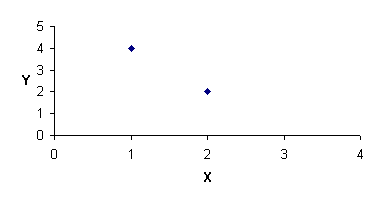
I. Mark 2 1m2 grids per group. Using a measuring tape, place a flagged stake at each of the four corners (1 m apart) so you can easily identify each of your two grids. On each grid, place a piece of flagging tape with a number on each flowering plant. Record the species for each numbered plant and its location on an x-y coordinate scheme for your plot. See Fig. 1. For each plant, also record the number of flowers or flower clusters in bloom.
II. Observe pollinators on your grids. In teams of 2, follow an individual pollinator as it visits plants on the grid. Identify the pollinator type (honeybee, bumblebee, syrphid fly, butterfly etc.). One person should call out the plant numbers as a single pollinator visits them, the other person should record the data. If a pollinator visits more than one flower per plant, record the plant number twice. We will assume that each successive visit results in pollen transfer.
Data Analysis
I. Calculate the following for plant species:
A. The density of each plant species per grid. If there are 100 daisies in 1 r~, then daisy density is 100/mZ.
B. The average distance between a flowering plant and its nearest same species neighbor (if abundant, randomly select 10 plants of a given species). The straight-line distance between two plants can be calculated based on the following equation:
Distance = Ö (x1-x2)+(y1-y2)2
where x1 = x coordinate of plant 1 and x2 = x coordinate of plant 2 and y1 = y coordinate of plant 1 and y2 = y coordinate of plant 2. To determine the average distance for a single species, add all distance measurements and divide by the number of measurements added. **This can be done most easily if you enter your data in spreadsheet form and then use cell formulae to do your calculations.
II. Calculate the following for pollinator activity:
A. The % of total pollination events (visits) yielding same species pollen transfer.
B. The % of total pollination events yielding cross-pollination (same species, different plant).
C. For all pollinator types with 5 or more individuals followed, analyze A and B separately by pollinator species as well.
D. Calculate the effective distance of pollen transfer. Using the equation above, for all visits between plants of the same species, determine the distance between those plants. Calculate an average distance for each plant species.
E. Plot plant species' densities vs. effective distance of pollen transfer.
Discussion
1. Describe the relationship between plant species' densities and the effective distance of pollen transfer.
2. How do different pollinator species differ in their pollination fidelity?
3. How effective are most pollinator visits in promoting cross-pollination?
4. Was there any variation in pollinator activity among plant grids? Did floral density differ among grids?
5. Describe the floral morphology and color visited by each of the pollinators. Were pollinators consistent in their floral morphotype selection?
Fig. 1
Literature Cited
Barth, F. G. 1991. Insects and Flowers. The biology of a partnership. Princeton Univ. Press, 408 pp.
Levin, D. and H. Kerster. 1969. The dependence of bee mediated pollen and gene dispersal upon plant density. Evolution 23: 560- 571.