

You are cordially invited to the 2026 LISA Symposium Public Lecture on
"Listening to the Dark Universe with Gravitational Waves and LISA”
by

Ira Thorpe
LISA Project Scientist for NASA
Tuesday, June 23, 2026
Doors open at 6 p.m.
Lecture begins at 6:30 p.m.
University of Maryland
Adele H. Stamp Student Union
Hoff Theater (Ground Floor)
3972 Campus Drive, College Park, MD 20742
Parking information
About the Talk
Almost everything we know about the unimaginably vast cosmos comes from observations of light. Over the centuries, our view of the universe has grown increasingly rich and detailed through technologies such as telescopes, CCDs, radio telescopes, high-energy detectors and space observatories. Yet even with these advances, parts of the universe remain hidden from us because they communicate not through light, but through ripples in spacetime itself.
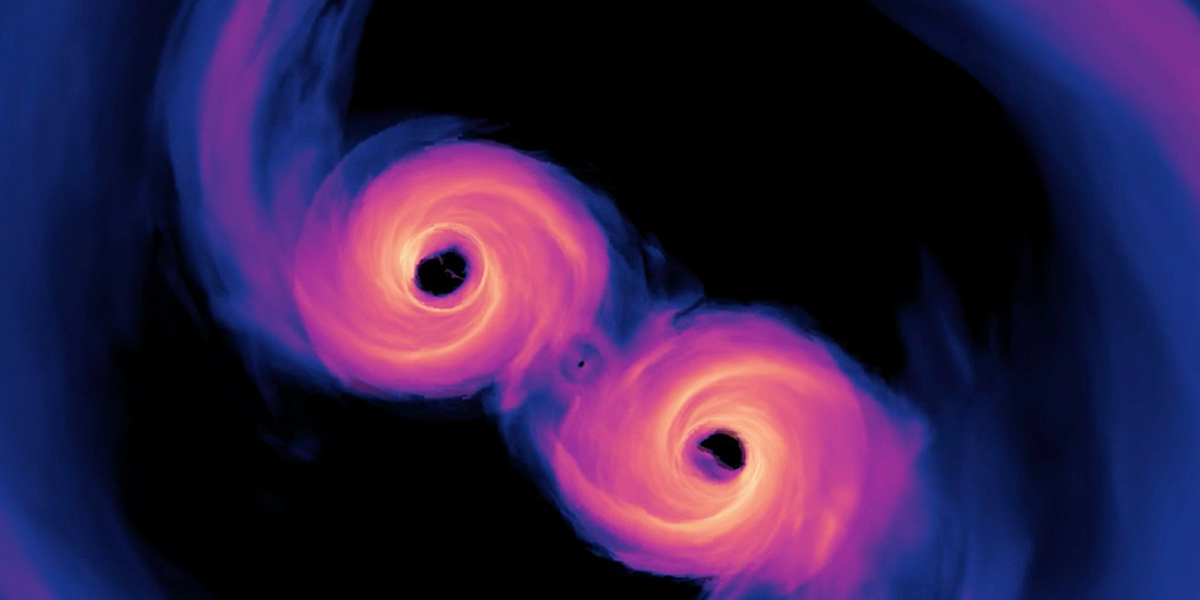
These ripples, known as gravitational waves, are produced by some of the most violent and energetic events in the cosmos: the collapse of stars, the collision of black holes and perhaps even the birth of the universe itself. In the last decade, international teams of scientists and engineers have developed an entirely new class of instruments that allows us to observe this gravitational-wave universe directly. The scientific impact of these discoveries has been profound, answering long-standing questions while revealing entirely new mysteries.
In the next decade, the Laser Interferometer Space Antenna (LISA) will bring this revolution into space, opening a new window onto the universe and offering unprecedented insights into black holes, galaxies and the evolution of the cosmos. In this talk, I will provide a ground-level introduction to gravitational waves, what we have learned so far and what LISA may teach us in the years ahead.
About the Speaker
Dr. James Ira Thorpe (M.S. ’02, physics) has devoted his career to the development of the Laser Interferometer Space Antenna (LISA), an ambitious international effort to construct a star-sized scientific instrument to detect ripples in the fabric of space-time known as gravitational waves. As the lead NASA LISA Project Scientist at NASA’s Goddard Space Flight Center, Dr. Thorpe has spent over two decades contributing to various aspects of LISA development, including prototyping instrumentation in the laboratory, modeling different configurations of the instrument, developing data analysis techniques and participating in a European-led on-orbit technology demonstrator mission. He holds bachelor's degrees in mechanical engineering and physics from Bucknell University, a master's degree in physics from the University of Maryland and a Ph.D. in physics from the University of Florida.
About the Symposium
The 16th International LISA Symposium highlights gravitational wave astrophysics, with a primary focus on the most up-to-date mission development, theory and analysis enabling the science to be performed with the Laser Interferometer Space Antenna (LISA). The symposium program includes invited talks and special sessions, complemented by talks, posters, questions and discussions. The Symposium is taking place on the University of Maryland campus. The local organizing committee includes faculty members from UMD's Departments of Astronomy and Physics and scientists from NASA’s Goddard Space Flight Center.
If you have a question about this event, including disability accommodations, please contact lisa2026-info@umd.edu.