


Science on Tap
A monthly lecture series at UMD that explores the latest discoveries in science and technology in a relaxed atmosphere with food and drink
"Quantum Possibilities: What the Weirdest Physics Can Build"
co-hosted with the City of College Park and presented by
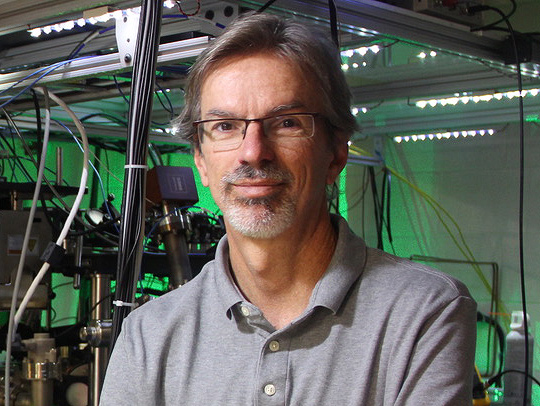
Steve Rolston
Physics Professor
University of Maryland
Thursday, September 24, 2026
Doors open at 6 p.m.
Lecture begins at 6:30 p.m.
Ledo Pizza
4509 Knox Rd.
College Park, MD 20740
Free pizza and soft drinks for event attendees will be provided by the City of College Park. Additional food and beverages will be available for purchase at the event.
Parking will be free in the attached city garage, courtesy of the City of College Park. Guests may enter the garage on Yale Avenue and should enter the event venue via the Ledo entrance on the corner of Knox Road and Yale Avenue.
If you have any questions about attending this event, including disability accommodations, please contact Rena Surana-Nirula at rena@umd.edu or 301-405-6563.
Abstract
It has been just over 100 years since the development of quantum mechanics, our theory of the microscopic world. By any measure, it has been a resounding success and is the most accurately tested theory ever developed. Its importance extends far beyond physics: quantum mechanics made possible the transistors and electronics found in every device that processes information — including phones, computers, internet infrastructure, robots and much more. It also lies at the heart of data storage, GPS and laser technology.
These advances constituted the “First Quantum Revolution.” Although quantum mechanics is renowned for its strange properties and surprising outcomes, the technologies of this first revolution did not generally harness its strangest features. We are now entering the “Second Quantum Revolution,” also known as Quantum 2.0, in which we are learning to exploit quantum weirdness itself. By doing so, we hope both to deepen our understanding of the universe and to build technologies that the pioneers of quantum mechanics could scarcely have imagined when they developed the theory.
At the heart of quantum weirdness is probability. Quantum mechanics can make only probabilistic predictions about the outcome of an individual measurement — even when we have the complete knowledge of the system. Then there is entanglement, in which measurements performed on two quantum systems can produce outcomes that cannot be explained by ordinary classical physics, even when the systems are separated by great distances. Although these ideas may challenge our philosophical view of the world, they are firmly established. Rather than treating them merely as oddities, we can view them as opportunities.
This lecture will move from these unusual features of quantum theory to how we can use them to make devices — quantum sensors, quantum networks and quantum computers. Like any new technology, there is hype and then there is reality. The speaker will envision the quantum 2.0 future without the hype.
This year, we are celebrating the 20th anniversary of the creation of the Joint Quantum Institute, a collaboration between the University of Maryland and the National Institute of Standards and Technology, and the fundamental reason College Park is known as the Capital of Quantum.
About the SPEAKER
Dr. Steven Rolston is a professor of physics at the University of Maryland. He received his Ph.D. in nuclear physics in 1986 from the State University of New York at Stony Brook. Following postdoctoral fellowships at the University of Washington and Harvard University, he joined the research staff at the National Institute of Standards and Technology in 1988. In 2003, he joined the physics faculty at the University of Maryland. He is a Fellow of the Joint Quantum Institute and the Quantum Technology Center and the founder of the Maryland Quantum Alliance. He served as co-director of the Joint Quantum Institute for nine years and recently concluded 10 years as chair of the Department of Physics. He is a Fellow of the American Physical Society, the Optical Society of America and the American Association for the Advancement of Science, and he has authored over 200 publications.
His research includes the first trapping of antimatter, laser cooling and trapping atoms to temperatures millions of a degree above absolute zero, Bose-Einstein condensation, atom lasers, ultracold plasmas, optical lattices, quantum simulation, quantum computing and quantum networking. He co-developed a general education course on energy and climate change and currently teaches a course on quantum technology.