


Science on Tap
A monthly lecture series at UMD that explores the latest discoveries in science and technology in a relaxed atmosphere with food and drink
"What’s Shaking on the Moon"
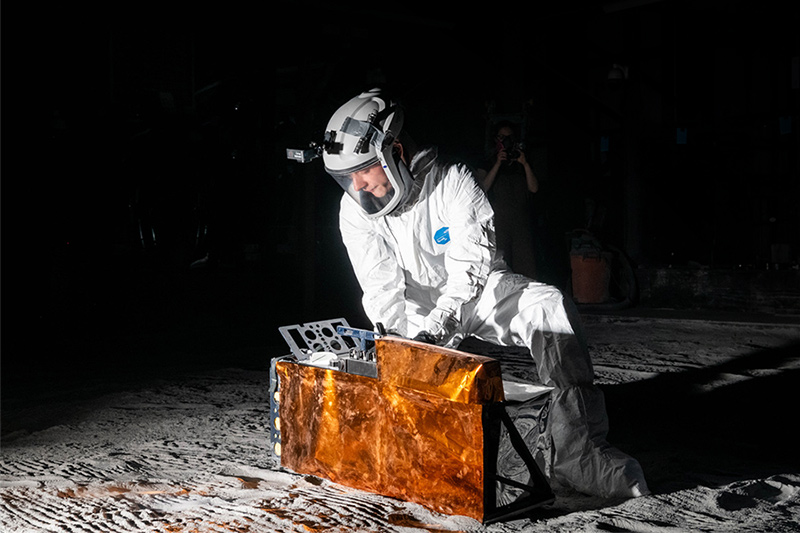
presented by

Nicholas Schmerr
Associate Professor
Geological, Environmental, and Planetary Sciences
University of Maryland
Tuesday, November 17, 2026
Doors open at 6 p.m.
Lecture begins at 6:30 p.m.
Ledo Pizza
4509 Knox Rd.
College Park, MD 20740
Food and beverages will be available for purchase at the event.
Register Now
Paid parking is available in the attached city garage, which guests can enter on Yale Avenue. Guests may enter the event venue via the Ledo entrance on the corner of Knox Road and Yale Avenue.
Subscribe to Receive Science on Tap Emails
If you have any questions about attending this event, including disability accommodations, please contact Rena Surana-Nirula at rena@umd.edu or 301-405-6563.
Abstract
Over 50 years ago, during the Apollo missions, astronauts left seismometers on the moon that recorded more than 13,000 moonquakes over an experiment that lasted seven years. That dataset gave us our first look inside another world, revealing the moon’s crust, mantle and core. But all four Apollo stations sat close together on the equator of the lunar near side, above a geologically anomalous region. That means our picture of the lunar interior remains incomplete. We know very little about quakes on the far side or about what lies beneath the poles. The Lunar Environment Monitoring Station (LEMS) for Artemis aims to change that. Two LEMS missions are planned for deployment near the lunar South Pole, both at the edge of the South Pole–Aitken basin, one of the largest and oldest impact craters in the solar system and a region no seismometer has ever explored. In the first LEMS, astronauts will bury two sensitive seismometers in the lunar soil to shield them from extreme temperature swings and help them listen to the ground more clearly. The second will be deployed on a robotic lander and expand to looking at the lunar exosphere, seismic and micrometeoroid environment. For both, a self-contained station will power them, keep them warm, store their data, and send it directly to Earth. The stations are designed to run on their own through the frigid two-week lunar night, with a goal of two or more years of continuous listening and monitoring the moon. This talk will explore why we’re going back, how you build an instrument to survive on the moon, and what these first long-lived science stations of the Artemis era might teach us about how the moon formed and evolved.
About the SPEAKER
Nicholas Schmerr is a planetary seismologist whose research examines the internal structure of Earth, Mars, the moon, and icy ocean worlds through the study of seismic waves. As a co-investigator on NASA's InSight mission to Mars, he helped confirm the first seismic detection of a planetary core beyond Earth and led investigations into the layered structure of the martian mantle and crust. His work on Earth's mantle transition zone has advanced understanding of mantle mixing and convection patterns from within. Schmerr currently serves as deputy principal investigator for an Artemis astronaut-deployed and robotic lunar missions (LEMS) and as principal investigator of the NASA SSERVI GEODES team, which develops geophysical methods to characterize natural resources on the Moon and other bodies for future exploration. At the University of Maryland, he has developed new courses in field geophysics and planetary exploration and has mentored numerous graduate students and postdoctoral researchers who now hold academic, research and industry positions around the world.